
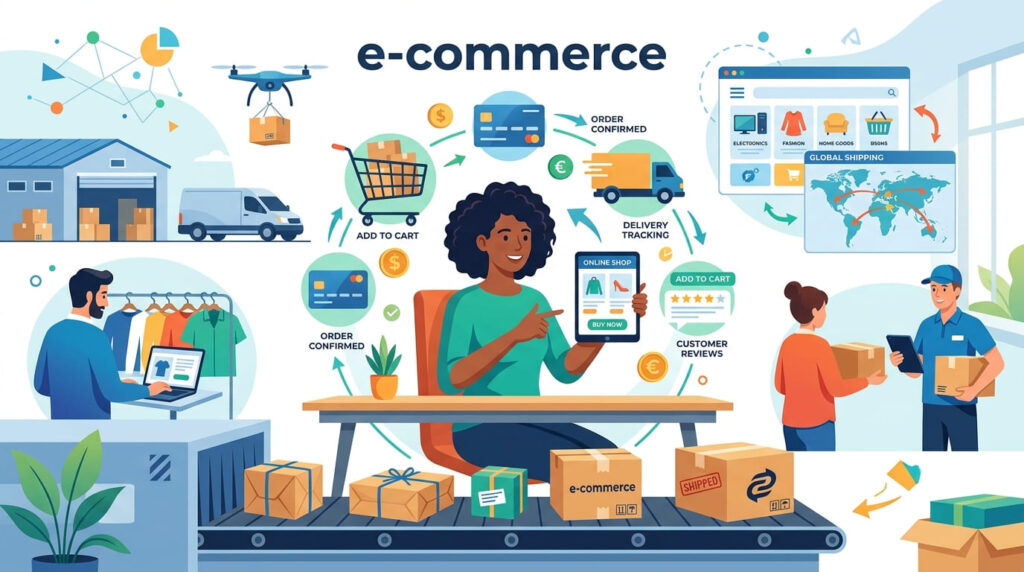

Artificial Intelligence (AI) is no longer a futuristic concept—it’s the silent engine powering some of the most successful online businesses today. From personalized shopping experiences to automated customer service, AI is transforming how e-commerce operates at every level. What once required entire teams can now be handled in seconds by intelligent systems, and this shift is reshaping not just businesses, but customer expectations as well.
Let’s take a deep dive into how AI is revolutionizing online businesses and e-commerce, and what it means for the future.
1. Personalized Shopping Experiences at Scale
One of the most visible impacts of AI in e-commerce is hyper-personalization. Modern consumers expect brands to “understand” them—and AI makes that possible.
AI algorithms analyze user behavior such as browsing history, purchase patterns, time spent on pages, and even scrolling habits. Based on this data, online stores can:
- Recommend products tailored to individual users
- Display dynamic homepage content
- Send personalized email campaigns
- Adjust pricing or promotions in real time
This is why when you visit an online store, it often feels like it already knows what you’re looking for. Personalization increases engagement, boosts conversion rates, and builds customer loyalty.
2. Smarter Customer Support with AI Chatbots
Customer service has undergone a major transformation thanks to AI-powered chatbots and virtual assistants.
Instead of waiting for human agents, customers can now:
- Get instant responses 24/7
- Track orders
- Resolve common issues
- Receive product recommendations
Advanced AI chatbots use natural language processing (NLP) to understand queries in a human-like way. Over time, they learn from interactions and become more accurate.
For businesses, this means reduced operational costs and faster response times. For customers, it means convenience and efficiency.
3. AI-Driven Inventory and Supply Chain Management
Managing inventory used to involve a lot of guesswork. Overstocking leads to losses, while understocking results in missed sales. AI eliminates much of this uncertainty.
AI systems can:
- Predict demand based on historical data and trends
- Optimize stock levels
- Automate reordering processes
- Identify supply chain inefficiencies
For example, during peak shopping seasons, AI can forecast which products will be in high demand and ensure they are stocked accordingly. This level of precision helps businesses operate more efficiently and reduce waste.
4. Visual Search and Image Recognition
Search is evolving beyond text. AI-powered visual search allows customers to upload an image and find similar products instantly.
This technology is especially useful in industries like fashion and home decor, where users may not know how to describe what they’re looking for.
AI image recognition enables:
- Finding products from photos
- Tagging and categorizing items automatically
- Enhancing product discovery
This removes friction from the buying process and makes shopping more intuitive.
5. Fraud Detection and Security Enhancements
As online transactions grow, so do security risks. AI plays a crucial role in detecting and preventing fraud.
AI systems monitor transactions in real time and look for unusual patterns, such as:
- Sudden high-value purchases
- Suspicious login locations
- Multiple failed payment attempts
When anomalies are detected, the system can flag or block transactions instantly. This protects both businesses and customers, building trust in online platforms.
6. Dynamic Pricing Strategies
AI allows businesses to implement dynamic pricing—adjusting prices based on demand, competition, customer behavior, and market conditions.
This means:
- Prices can change in real time
- Businesses can remain competitive
- Profit margins can be optimized
For example, during high demand, prices may increase slightly, while discounts may be offered to hesitant buyers to encourage conversions.
7. AI in Marketing and Advertising
Marketing has become more data-driven than ever, and AI is at the center of it.
AI helps businesses:
- Identify target audiences with precision
- Optimize ad placements
- Generate content (including product descriptions and ads)
- Predict campaign performance
Instead of guessing what might work, businesses can rely on AI insights to make smarter marketing decisions, resulting in higher ROI.
8. Voice Commerce and Conversational Shopping
With the rise of voice assistants, shopping is becoming more conversational.
Customers can now:
- Search for products using voice commands
- Place orders hands-free
- Get recommendations through smart devices
AI understands natural speech patterns and delivers relevant results, making the shopping experience more seamless.
9. Automation of Routine Business Operations
AI is not just customer-facing—it also streamlines backend operations.
Tasks that can now be automated include:
- Data entry
- Order processing
- Email responses
- Analytics reporting
This frees up human teams to focus on strategy, creativity, and growth rather than repetitive tasks.
10. Predictive Analytics for Better Decision-Making
Perhaps the most powerful aspect of AI is its ability to predict future outcomes.
AI can analyze vast amounts of data to forecast:
- Customer behavior
- Sales trends
- Market shifts
Businesses can use these insights to make proactive decisions instead of reactive ones. This creates a significant competitive advantage in fast-moving markets.
Challenges and Ethical Considerations
While AI offers immense benefits, it also comes with challenges:
- Data privacy concerns
- Algorithm bias
- Dependence on automation
- High implementation costs for small businesses
Companies must strike a balance between innovation and ethical responsibility, ensuring transparency and fairness in how AI is used.
The Future of AI in E-commerce
The role of AI in online business is only going to expand. In the near future, we can expect:
- Even more advanced personalization
- Fully automated online stores
- Augmented reality (AR) shopping experiences
- AI-generated virtual influencers and sales agents
Businesses that adopt AI early and strategically will be better positioned to thrive in an increasingly competitive digital landscape.
Final Thoughts
AI is not just enhancing e-commerce—it is redefining it. From how customers discover products to how businesses manage operations, every aspect of online commerce is being reshaped.
For entrepreneurs and business owners, the message is clear: embracing AI is no longer optional. It’s a necessity for staying relevant, competitive, and future-ready.
As technology continues to evolve, those who leverage AI effectively will not only meet customer expectations—but exceed them in ways we are only beginning to imagine.